Corporate: Sanepa, Lalitpur, Nepal Factory: Bardaghat, Nawalparasi, Nepal

CPVC Pipe Price in Nepal: Complete Kishan Pipe Guide on Types, Uses & Buying Tips
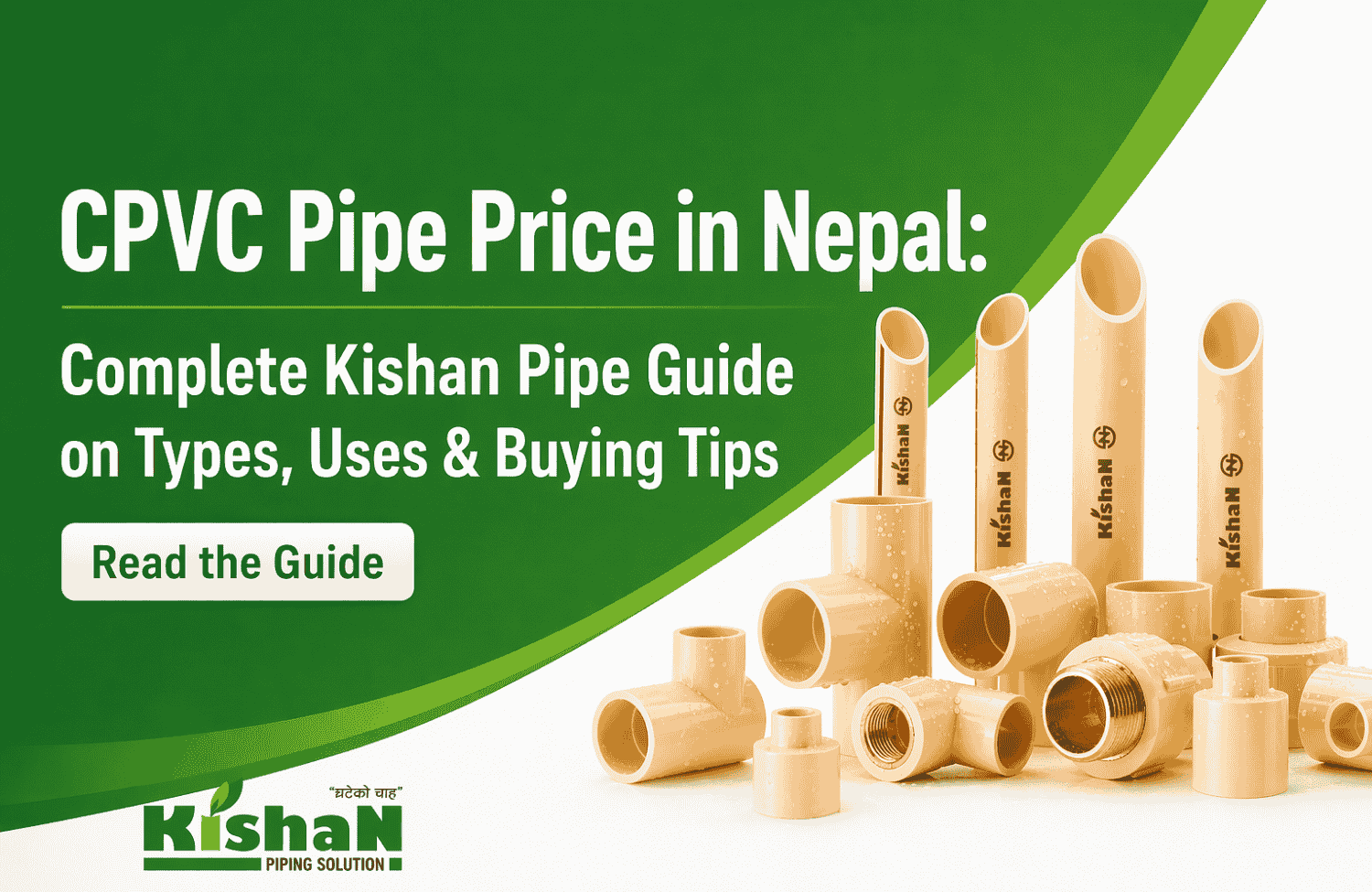
CPVC pipe price in Nepal is one of the most searched topics among homeowners, contractors, and builders planning hot and cold water plumbing systems. Chlorinated Polyvinyl Chloride (CPVC) pipes have become the go-to choice for modern plumbing in Nepal due to their ability to handle high temperatures, resistance to corrosion, and long service life. Understanding CPVC pipe price in Nepal, available sizes, SDR ratings, and quality certifications helps buyers and contractors choose the right piping solution for their specific project needs.
In this guide, we explore the key factors affecting CPVC pipe price in Nepal, common types and sizes available at Kishan Pipe, their applications, and important tips to consider before purchasing.
Quick Answer: CPVC pipe price in Nepal varies mainly by size (15mm–50mm), SDR rating (SDR11 for hot water/high pressure, SDR13.5 for standard plumbing), and brand/certification quality. Kishan Pipe manufactures its CPVC pipes as per NS 570 and CPVC ASTM D-2846 standards, with SDR11 (thicker wall) costing more than SDR13.5 (standard wall) at the same size. For exact rates, buyers should contact the manufacturer directly, as prices fluctuate with raw material costs and market conditions.
What Are CPVC Pipes?
CPVC (Chlorinated Polyvinyl Chloride) pipes are high-performance thermoplastic pipes specifically engineered for hot- and cold-water distribution systems. Unlike standard PVC pipes, CPVC undergoes an additional chlorination process that significantly increases its heat tolerance and pressure handling capacity.
Some important advantages of CPVC pipes include:
- Handles high temperatures without softening or deforming
- Non-toxic and lead-free, safe for drinking water supply
- Highly resistant to corrosion, rust, and chemical attack
- Lightweight and easy to transport and install
- Smooth inner surface for efficient water flow with minimal friction loss
- Long service life of 50+ years under standard conditions
- Cost-effective compared to copper or stainless steel alternatives
Due to these advantages, CPVC pipes are widely used across Nepal in residential, commercial, and institutional plumbing projects.

Why CPVC Pipes Are Popular in Nepal
CPVC pipes are widely used across Nepal because they are durable, heat-resistant, and suitable for both hot- and cold-water plumbing applications. Their ability to handle Nepal’s varying water conditions, combined with ease of installation, makes them a reliable solution for both small household projects and large-scale construction works. Some of the most common applications of CPVC pipes in Nepal include:
1. Residential Hot and Cold Water Plumbing
CPVC pipes are the ideal choice for home plumbing systems, including bathrooms, kitchens, and geyser connections. Their ability to carry hot water without deforming makes them especially suitable for shower lines, boiler connections, and hot water distribution throughout the home.
2. Commercial and Institutional Buildings
Hotels, hospitals, schools, and office buildings rely on CPVC pipes for central hot- and cold-water distribution. Their long service life and minimal maintenance requirements make them a cost-effective solution for large-scale plumbing infrastructure.
3. Solar Water Heating Systems
CPVC pipes are highly compatible with solar water heating systems, which are increasingly popular in Nepal. The high thermal tolerance of CPVC ensures the pipes handle the elevated water temperatures generated by solar panels without degradation.
4. Industrial Fluid Handling
In industrial settings, CPVC pipes are used to transport hot chemicals and industrial water. Their corrosion resistance and pressure handling capacity make them suitable for demanding industrial environments.
5. Fire Sprinkler Systems
Certain grades of CPVC pipes meet fire-resistance standards and are used in low-hazard fire suppression systems in commercial and institutional buildings.
CPVC Pipe Price in Nepal: Size, SDR Rating & Rate List (Kishan Pipe)
CPVC pipe price in Nepal depends on several factors, including pipe size (diameter), SDR rating (wall thickness), and the manufacturer’s quality standard. Kishan Pipe manufactures CPVC pipes as per the CPVC ASTM D-2846 standard and offers two SDR options: SDR11 and SDR13.5.
1. Pipe Size and Diameter
Common CPVC pipe sizes available at Kishan Pipe include:
- 15 mm
- 20 mm
- 25 mm
- 32 mm
- 40 mm
- 50 mm
2. SDR Rating
SDR (Standard Dimension Ratio) indicates the ratio of pipe diameter to wall thickness. A lower SDR number means a thicker wall and higher pressure capacity.
- SDR11 – Thicker wall, higher pressure resistance, suitable for hot water lines and high-pressure systems
- SDR13.5 – Standard wall thickness, suitable for general cold and warm water plumbing
3. CPVC Pipe List – SDR11 (Kishan Brand)
| Size (mm) | PCS/PKT |
|---|---|
| 15 | 50 |
| 20 | 30 |
| 25 | 20 |
| 32 | 10 |
| 40 | 10 |
| 50 | 10 |
4. CPVC Pipe List – SDR13.5 (Kishan Brand)
| Size (mm) | PCS/PKT |
|---|---|
| 15 | 50 |
| 20 | 30 |
| 25 | 20 |
| 32 | 10 |
| 40 | 10 |
| 50 | 10 |
5. Raw Material Quality
The quality of CPVC resin used during manufacturing significantly affects pipe durability and performance. Kishan Pipe uses premium-grade raw materials and advanced production technology to ensure consistent quality and long-term reliability.
CPVC Fittings in Nepal (Kishan Pipe)
CPVC pipe fittings are an essential part of any plumbing system. Kishan Pipe manufactures a comprehensive range of CPVC fittings as per the CPVC ASTM D-2846 standard. Below is a summary of key fitting:
| Fitting Type | Size (mm) |
|---|---|
| Coupling | 15 |
| Coupling | 20 |
| Coupling | 25 |
| 90° Elbow | 15 |
| 90° Elbow | 20 |
| 90° Elbow | 25 |
| Tee | 15 |
| Tee | 20 |
| Tee | 25 |
| Ball Valve | 15 |
| Ball Valve | 20 |
| Ball Valve | 25 |
| Union | 15 |
| Union | 20 |
| Union | 25 |
| End Cap | 15 |
| End Cap | 20 |
For a complete fittings price list including male adapters, female adapters, brass couplings, reducers, and concealed valves, visit the Kishan CPVC Pipes and Fittings page.
Quality and Certification of Kishan CPVC Pipes
Quality certification plays an important role in ensuring the reliability and long-term performance of CPVC pipes. Kishan Pipe manufactures CPVC pipes and fittings in accordance with recognized quality standards such as Nepal Standard (NS) 570 and CPVC ASTM D-2846, ensuring consistent wall thickness, adequate pressure resistance, and safe material composition suitable for hot and cold water plumbing.
Each pipe is produced under strict quality-control processes to maintain durability and performance in real-world conditions. By following certified manufacturing standards, Kishan Pipe ensures its CPVC pipes meet the performance requirements for Nepal’s diverse geographic and environmental conditions, delivering dependable performance, reduced leakage risk, and long service life.
Choosing NS 570-certified CPVC pipes from a trusted manufacturer like Kishan Pipe helps ensure better quality, durability, and reliability for both residential and large-scale pipeline installations.
Types of CPVC Pipes and Fittings Available at Kishan Pipe
Different CPVC pipe and fitting types are manufactured to serve various plumbing applications.
1. CPVC Pipe SDR11
Thicker-walled pipes designed for hot water lines and higher-pressure plumbing systems. Recommended for geyser connections, solar water lines, and industrial applications.
2. CPVC Pipe SDR13.5
Standard-wall pipes suitable for general hot and cold water plumbing in residential and commercial buildings.
3. CPVC Fittings Range
Kishan Pipe offers a complete range of precision-engineered CPVC fittings including:
- Couplings and Reducer Couplings
- 90° and 45° Elbows
- Tees and Reducing Tees
- Male and Female Adapters
- Brass and Copper Thread Fittings
- Ball Valves
- Unions
- End Caps
- Concealed Valves
- Clips and Metal Clips
CPVC Pipes vs Other Materials (UPVC/HDPE): What You Should Know
Different types of plastic pipes are used in construction and water systems in Nepal, each suited to specific applications.
- CPVC vs UPVC: UPVC pipes are suitable for cold water supply and drainage systems, but they are not designed for hot water applications. CPVC, with its higher chlorine content, can safely handle water temperatures up to 93°C, making it the preferred choice wherever hot water lines are required.
- CPVC vs HDPE: HDPE pipes are more flexible and are typically used for underground pipelines, irrigation systems, and high-pressure water distribution. CPVC is rigid and better suited for indoor plumbing and hot water systems within buildings.
- CPVC vs Metal Pipes: Compared to copper or GI pipes, CPVC is significantly lighter, easier to install, does not rust or scale, and costs less. This makes CPVC a superior long-term choice for modern plumbing systems in Nepal.
For a detailed comparison, read:
- Comparing UPVC and CPVC Pipes: Which is Right for Your Project?
- CPVC Plumbing Pipes: Complete Guide for Homes in Nepal (2026)
Tips Before You Buy CPVC Pipes in Nepal
Before purchasing CPVC pipes, consider the following factors:
- Check the pipe size and diameter required for your plumbing layout
- Choose the correct SDR rating based on whether you need hot water (SDR11) or general plumbing (SDR13.5)
- Verify that the pipes comply with NS 570 and ASTM D-2846 standards
- Ensure fittings are from the same manufacturer and standard to guarantee leak-proof joints
- Check the raw material quality and whether the manufacturer uses virgin CPVC resin
- Choose a reliable, certified manufacturer
These steps help ensure that the piping system performs efficiently and lasts for decades. For a detailed breakdown of fitting options and pricing, visit the Kishan CPVC Pipes and Fittings page.
Why Quality and Manufacturer Choice Matter
Selecting a reliable manufacturer is essential when purchasing CPVC pipes in Nepal. High-quality pipes are produced using advanced manufacturing processes and strict quality-control standards.
A trusted manufacturer ensures:
- Consistent product quality and accurate pipe dimensions
- Reliable pressure and heat resistance across all sizes
- Proper certification and compliance testing (NS 570, ASTM D-2846)
- Precision-engineered fittings that pair perfectly with their pipes
Choosing a reputable manufacturer helps avoid problems such as pipe leakage, cracking under hot water pressure, or premature failure in demanding plumbing systems.
Understanding SDR Ratings in CPVC Pipes
The SDR (Standard Dimension Ratio) rating indicates the relationship between a pipe’s outside diameter and its wall thickness.
- SDR11 – Thicker wall, higher pressure and temperature resistance. Best for hot water supply lines, geyser connections, and solar water systems.
- SDR13.5 – Thinner wall with a lower pressure rating. Suitable for standard residential cold- and warm-water plumbing where extreme heat resistance is not required.
Choosing the correct SDR rating ensures the pipe performs safely and efficiently under the expected operating conditions.
Choosing the Right Size and Application Type
Selecting the correct pipe size is important for maintaining proper water flow and system efficiency. For CPVC pipes, common applications by size include:
- 15 mm – Individual bathroom and kitchen outlets, geyser connections
- 20 mm – Branch lines in residential plumbing
- 25 mm – Main supply lines within the floors of residential buildings
- 32–40 mm – Main risers in multi-story buildings
- 50 mm – Main water supply entry lines and commercial building distribution
Choosing the right size prevents pressure drops and ensures efficient water delivery throughout the system.
Why NS 570 Certification Matters
Manufacturing standards ensure that CPVC pipes meet required safety and performance levels. Certified pipes are tested for thermal resistance, pressure capacity, and durability before they reach the market.
Pipes produced according to the NS 570 standard provide consistent quality and reliable long-term performance in Nepal’s diverse conditions, from the high-altitude cold of mountain regions to the heat of the Terai plains. This certification also ensures that pipes can safely handle chemically treated municipal water without degradation.
How to Get the Best CPVC Pipes in Nepal Without Compromising Quality
When purchasing CPVC pipes in Nepal, buyers should focus on both price and quality. While comparing CPVC pipe prices is important, selecting certified pipes from a trusted manufacturer ensures better long-term value and fewer plumbing problems.
Kishan Pipe manufactures reliable CPVC pipes and fittings for hot- and cold-water plumbing systems across Nepal. With a complete range of pipe sizes in SDR11 and SDR13.5, plus a comprehensive range of fittings, Kishan Pipe focuses on high-quality manufacturing and durable piping solutions for Nepal’s diverse residential, commercial, and industrial applications.
Explore Our Products:
Need help choosing the right CPVC pipes? Contact us today to explore our range of NS 570-certified CPVC pipes and fittings suitable for different applications and project requirements.
📞 Call us: 01-5184040, 078-411088 📧 Email: admin@kishanpipe.com.np
Conclusion
CPVC pipes are an essential component of modern plumbing in Nepal, supporting a wide range of applications including hot water supply, geyser and solar water system connections, commercial building distribution, and industrial fluid handling. Their ability to withstand temperatures up to 93°C, combined with corrosion resistance, long service life, and ease of installation, makes them a superior choice over metal pipes and standard PVC for hot water applications.
Understanding CPVC pipe price in Nepal, SDR ratings, available sizes, and quality certifications helps buyers choose the right piping solution for their specific needs. Selecting pipes that meet NS 570 and ASTM D-2846 standards ensures better performance, thermal safety, and dependable long-term operation.
Manufacturers like Kishan Pipe focus on producing high-quality CPVC pipes and fittings that meet Nepal’s residential and commercial plumbing requirements. With a commitment to quality manufacturing and adherence to national and international standards, Kishan Pipe continues to support Nepal’s construction sector by delivering reliable CPVC piping solutions for hot and cold water systems nationwide.
FAQs
1. What is the difference between SDR11 and SDR13.5 CPVC pipes?
SDR11 pipes have a thicker wall and higher pressure and temperature resistance, making them ideal for hot water lines and geyser connections. SDR13.5 pipes are standard wall thickness and are suited for general cold and warm water plumbing.
2. Are CPVC pipes safe for drinking water in Nepal?
Yes. Kishan’s CPVC pipes are made from non-toxic, lead-free materials, making them completely safe for potable water supply in homes, schools, and hospitals.
3. What temperature can CPVC pipes handle?
Kishan CPVC pipes are engineered to withstand high temperatures, making them suitable for hot-water supply, geyser connections, and solar water-heating systems.
4. What standard do Kishan CPVC pipes follow?
Kishan CPVC pipes and fittings are manufactured in compliance with Nepal Standard (NS) 570 and ASTM D2846 for CPVC, ensuring consistent quality, safety, and reliable performance for hot and cold water plumbing systems in Nepal.
5. How long do CPVC pipes last in Nepal?
With proper installation and use, CPVC pipes and fittings are designed to last 50+ years, offering long-term durability with minimal maintenance requirements.