Corporate: Sanepa, Lalitpur, Nepal Factory: Bardaghat, Nawalparasi, Nepal

How Fittings Shape Your Plumbing System: Understanding Tees, Elbows, Couplers & More
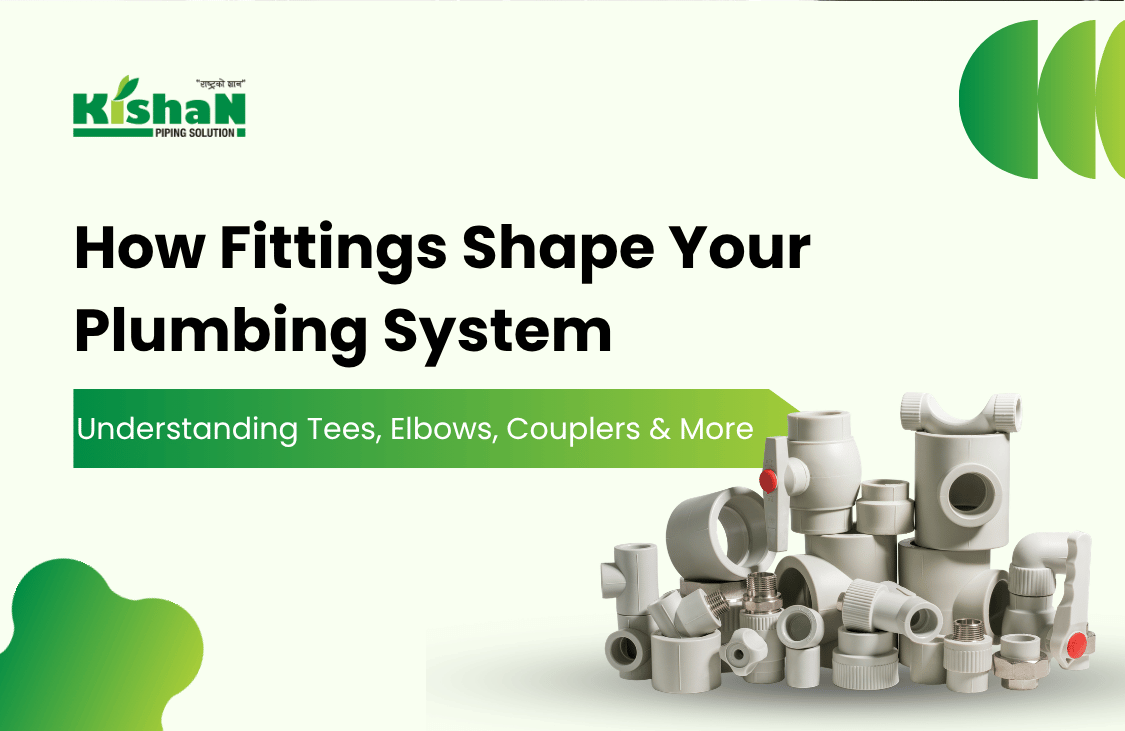
When most people think about plumbing, they imagine long stretches of pipes running behind walls or beneath floors. But the truth is, pipes alone cannot create a full plumbing system. The real work happens at the joints—where pipes need to turn, connect, branch, or stop. That is where fittings come in.
If you’ve ever wondered how water moves smoothly around corners or how pipes stay tightly connected without leaking, it all comes down to the different types of pipe fittings used in the system. In this blog, let’s break down these fittings simply and practically, and see why choosing strong, reliable ones—like those from Kishan Pipe—can make your entire plumbing network safer and long-lasting.
Why Fittings Matter More Than You Think
Pipes can only carry water in straight lines. But your home or building needs water to move in different directions—upwards to bathrooms, sideways into the kitchen, or downward into drains. Fittings make all this possible.
Here’s what good fittings do:
- Hold pipes together tightly
- Prevent leaks at connection points
- Help water change direction smoothly
- Connect pipes of different sizes
- Allow branching into multiple lines
So even though fittings look small, they are responsible for keeping the entire plumbing layout stable and leak-free. Poor-quality fittings are one of the biggest reasons plumbing systems fail. That’s why professionals always choose trusted brands like Kishan Pipe, which offers strong and durable UPVC and CPVC fittings designed to last.
Understanding the Main Types of Pipe Fittings
Let’s look at some of the most common fittings used in Nepali homes, offices, and large projects. These are the parts you’ll find in almost every plumbing system, whether it’s for cold or hot water.
1. Couplers – For Extending or Joining Pipes
A coupler simply connects two pipes in a straight line.
If you need to extend a pipe or join two pieces together, a coupler is the easiest way to do it.
Where it’s used:
- Extending the length of a water supply line
- Repairing damaged pipe sections
- Connecting pipes of the same size
Couplers from Kishan Pipe are known for their tight, leak-proof grip and smooth internal finish, which helps maintain good water flow.
2. Elbows – For Changing Direction
Elbows allow the pipe to bend. Instead of forcing the pipe to curve, elbows create clean, sharp angles that keep the flow smooth.
Common angles:
- 90° elbow: sharp turn
- 45° elbow: gentle bend
Used in:
- Bathroom fittings
- Kitchen sinks
- Any place water needs to go around a corner
Kishan Pipe’s UPVC and CPVC elbows are strong, durable, and don’t deform even after long-term use.
3. Tees—For Splitting Water Flow
A tee fitting has a T-shape, allowing one pipe to branch into two directions.
It helps distribute water from one line to multiple rooms or fixtures.
Common uses:
- Splitting the line into bathroom + kitchen
- Creating separate lines for hot and cold water
- Branching into overhead tanks
Tees play a big role in system design because they decide how water will reach different areas of a building.
4. Reducers – For Connecting Different Pipe Sizes
A reducer connects a larger pipe to a smaller one (or vice versa).
Plumbing systems often use pipes of various diameters, and reducers help smoothly transition between them.
Useful for:
- Managing water pressure
- Connecting tanks to supply lines
- Fitting CPVC hot water lines into UPVC main lines
Kishan Pipe reducers are designed to keep the internal flow steady so pressure loss is minimal.
5. End Caps – For Closing Pipe Ends
End caps are used to close a pipe opening.
They’re simple but essential because they seal off unused or future connection points.
Used in:
- Temporary pipe closures
- Sealing ends during construction
- Finishing unused branches in plumbing lines
A good end cap prevents leaks and keeps the system safe from water overflow or pressure buildup.
Kishan Pipe Fittings: Strong, Reliable, and Built to Last
Both UPVC and CPVC fittings from Kishan Pipe are designed to perform well in Nepali conditions.
UPVC (for cold water systems):
- Does not rust
- Resistant to scaling
- Smooth internal surface
- Lightweight and easy to install
CPVC (for hot water systems):
- Can handle high temperatures
- Strong and long-lasting
- Leak-resistant joints
- Manufactured as per ASTM D-2846
Every Kishan Pipe fitting is made under ISO 9001:2008 certification, ensuring consistency and quality control. These fittings are trusted in large projects across Nepal because they reduce long-term maintenance and provide years of reliable performance.
How Fittings Shape the Entire Plumbing System
A plumbing system is like a network of roads. Pipes are the highways, but fittings are the intersections, turns, and connectors that guide everything smoothly.
Without the right fittings:
- Water would leak at every turn
- Pressure would drop
- Flow direction would be unpredictable.
- Repairs would be frequent and expensive
Well-designed fittings create a clean, organized, and efficient plumbing layout. When those fittings come from a brand like Kishan Pipe, users get the added assurance of durability and long-term performance.
Call to Action
If you’re building, renovating, or upgrading your plumbing system, choosing the proper fittings matters just as much as selecting good pipes.
For trusted quality, strong joints, and leak-proof performance, choose Kishan Pipe UPVC and CPVC fittings. You can find them at authorized distributors across Nepal, contact us, or visit Kishan Pipe directly for more details or product support.
Frequently Asked Questions (FAQs)
1. What are the most common types of pipe fittings?
The main types include couplers, elbows, tees, reducers, and end caps.
2. Are UPVC and CPVC fittings used for different purposes?
Yes. UPVC is ideal for cold-water systems, while CPVC is suitable for both hot and cold water.
3. Do Kishan Pipe fittings prevent leaks?
Yes. Kishan Pipe fittings are designed for tight, secure joints and long-term leak protection.
4. Are these fittings durable?
They are made from high-quality materials and tested as per industry standards for strength and reliability.
5. Where can I buy Kishan Pipe fittings?
They’re available at authorized distributors across Nepal, and you can contact Kishan Pipe for product guidance.