Corporate: Sanepa, Lalitpur, Nepal Factory: Bardaghat, Nawalparasi, Nepal

UPVC Pipe Price in Nepal 2026: Types, Uses & Complete Buying Kishan Pipes Guide
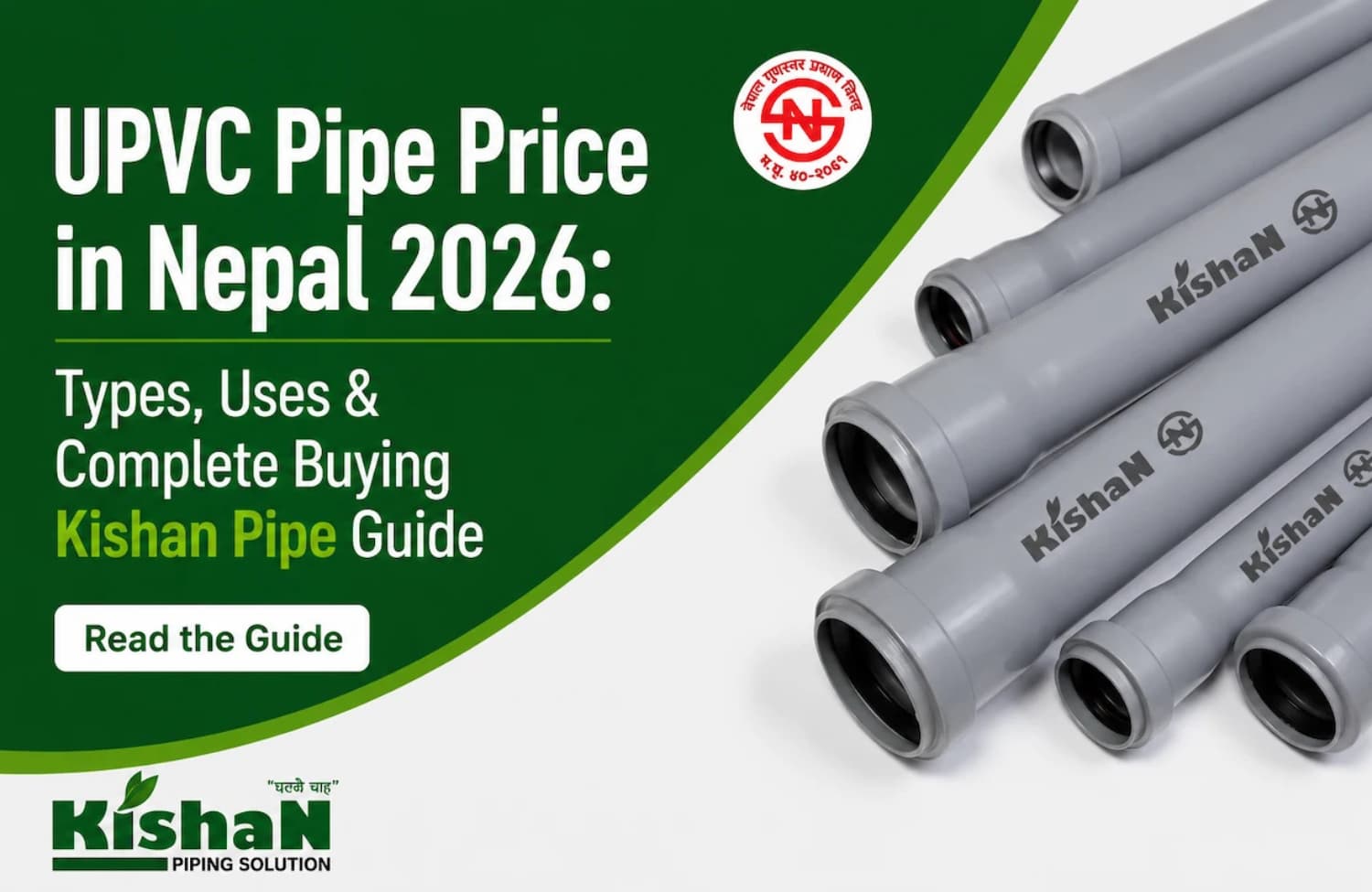
If you are planning a home build, renovation, or any plumbing project in Nepal, chances are you have already come across UPVC pipes. They are widely used across the country, in housing colonies in Lalitpur, commercial buildings in Pokhara, drainage systems in Butwal, and borewell setups across the Terai. But when it comes to understanding the UPVC pipe price in Nepal, what you actually get for that price, and which UPVC type is right for your specific project, most buyers are left guessing.
This guide fixes that. Whether you are a contractor pricing a job, a homeowner comparing options, or an engineer sourcing materials for a large project, here is everything you need to know about Kishan UPVC pipes in Nepal, from product types and their ideal uses to what to look for before you buy.
What Is a UPVC Pipe and Why Is It Popular in Nepal?
UPVC stands for Unplasticised Polyvinyl Chloride. Unlike ordinary plastic pipes, UPVC contains no plasticisers, which means it is harder, more rigid, and significantly more durable under pressure. It does not rust, corrode, or react with water or soil chemicals, and requires almost no maintenance over its service life.
For Nepal’s diverse conditions, from the humid Terai plains to hilly districts with varying temperatures,UPVC pipes offer a level of reliability that older metal pipes simply cannot match. They are lighter to transport, easier to install, and hold up far longer under real-world operating conditions.
The key advantage of UPVC over standard PVC is rigidity and pressure tolerance. UPVC is engineered for pressurised water supply, drainage, borewell applications, and underground distribution networks, exactly the conditions most Nepali construction projects demand.
Kishan UPVC Pipe Types: Which One Is Right for Your Project?
Kishan manufactures five distinct types of UPVC pipes, each engineered for a specific application. Understanding the difference helps you choose the right product and avoid overspending or under-specifying.
1. UPVC Pipes-NS:206 Certified
This is Kishan’s flagship UPVC pipe, NS-certified, meaning every batch is tested and approved against Nepal Standard NS:206 for pressure durability, wall thickness, and material quality.
Available sizes: 50mm (1½”), 75mm (2½”), 90mm (3″), 110mm (4″), 160mm (6″), 200mm (8″)
Available pressure ratings: 2.5 kgf/cm², 4 kgf/cm², 6 kgf/cm², 10 kgf/cm² (not all sizes available at all pressure classes; contact Kishan for specific availability)
Best for:
- Residential cold water supply lines
- Commercial and institutional plumbing systems
- Pressurised water distribution networks
- Underground water supply in municipal and rural schemes
- Drainage and sewage systems in buildings
Why choose UPVC Pipes-NS:206 certified?
The NS:206 certification is your assurance that the pipe has been independently tested to meet Nepal’s national quality standards. It is slightly more premium-priced than other UPVC variants, but it is the right choice when your project demands certified performance and long-term reliability. If you are building a home, a school, a hospital, or any structure where water supply quality and pipe durability cannot be compromised, this is the pipe to specify.
Learn More: Nepal Standard (NS) Certified Pipes in Nepal: What They Mean & Why They Matter
2. UPVC Borewell Pipe-BS:3505 Certified
Kishan’s borewell-grade UPVC pipes are manufactured and certified to BS:3505, the British Standard for unplasticised PVC pipes used in borewell and underground water extraction applications.
Available sizes: 48mm (1½”), 60mm (2″), 90mm (3″), 114mm (4″), 168mm (6″)
Available classes: BSC, BSD, BSE (higher class = thicker wall = greater depth and pressure tolerance)
Best for:
- Borewell casing and water extraction
- Deep underground water supply installations
- High-pressure underground water pipelines
- Areas where soil conditions demand certified structural strength
Why choose a UPVC Borewell pipe?
If your project involves a borewell in the Kathmandu Valley, the Terai plains, or anywhere groundwater is the primary source, the BS:3505-certified pipe is the standard requirement. The three class options (BSC, BSD, BSE) let you match wall thickness and cost precisely to your borewell depth and pressure needs.
3. UPVC Gold Pipe-The Budget-Friendly Option
Kishan’s UPVC Gold Pipe is specifically designed for projects where cost efficiency is a priority without completely compromising on UPVC performance.
Available sizes: 50mm (1½”), 75mm (2½”), 110mm (4″)
Available pressure ratings: 4 kgf/cm², 6 kgf/cm²
Best for:
- Cost-conscious residential plumbing projects
- Secondary water lines and non-critical supply runs
- Projects where the budget is the primary constraint
Why choose UPVC Gold Pipe?
The Gold Pipe is Kishan’s most affordable UPVC option, making it the go-to choice for buyers who need UPVC performance at a lower price point. It is ideal for contractors managing tight project budgets or homeowners looking for a reliable but economical pipe for secondary plumbing lines. If the NS:206 certified pipe is the premium choice, the Gold Pipe is the practical everyday alternative.
4. UPVC Solfit Borewell Pipe
The Solfit Borewell Pipe is Kishan’s lighter-duty borewell pipe option, available in Class A, Class B, and Class C variants for the 110mm (4″) size.
Available size: 110mm (4″)
Available classes: Class-A, Class-B, Class-C
Best for:
- Borewell installations where lighter pipe specifications are acceptable
- Shallow to medium-depth borewell setups
- Projects that need a borewell-capable pipe at a more accessible price than the full BS:3505-certified range
Why choose this pipe? The Solfit Borewell Pipe fills the gap between the heavy-duty BS:3505-certified range and standard plumbing pipes. If your borewell project does not require the full structural specification of BS:3505, the Solfit is a practical middle-ground choice.
5. UPVC Flow Glass Mate Pipe-The Transparent UPVC Pipe
The Flow Glass Mate is Kishan’s transparent UPVC pipe ,a unique product that allows you to visually monitor water flow, check for blockages, and inspect pipe condition without cutting into the line.
Available sizes: 75mm (2½”), 110mm (4″)
Available pressure rating: 4 kgf/cm²
Best for:
- Applications where visual flow monitoring is required
- Laboratory and industrial setups needing flow visibility
- Any installation where the ability to see through the pipe adds practical value
- Quality-conscious plumbing setups where inspecting flow without disruption is important
Why choose a UPVC Flow Glass Mate Pipe?
No other standard pipe type lets you see what is happening inside. The Flow Glass Mate is a specialist product, perfect for situations where transparency is a functional requirement, not just an aesthetic preference.
UPVC Fittings: What You Need Beyond the Pipe
A piping system is only as strong as its fittings. Kishan manufactures a complete range of UPVC SWR fittings designed to match its pipe range precisely. Available fittings include:
- Couplers: available in 50mm, 75mm, 110mm, 160mm
- Bends (87.5° and 45°): available in 50mm, 75mm, 110mm, 160mm
- Bend 87.5° with Door: available in 75mm, 110mm, 160mm
- Single Tee: available in 50mm, 75mm, 110mm, 160mm
- Single Tee with Door: available in 75mm, 110mm, 160mm
- Single “Y”: available in 75mm, 110mm
- Single “Y” with Door: available in 75mm, 110mm
- Double Tee: available in 75mm, 110mm
- Double Tee with Door: available in 75mm, 110mm
- Reducer: available in 75×50mm, 110×75mm, 160×110mm
- Reducer Tee: available in 110×75mm
- Socket Plug / End Cap: available in 50mm, 75mm, 110mm, 160mm
- Nahani Trap: available in 110mm
- “P” Trap: available in 110×110mm and 110×125mm
- Cleaning Pipe: available in 75mm, 110mm
- Multifloor Trap: available in 110×75mm
- Square Tile with Jali: available in 110mm
- Square Tile: available in 110mm
- Round Jali: available in 110mm
- Pipe Clip: available in 50mm, 75mm, 110mm
- Metal Clip: available in 50mm, 75mm, 110mm, 160mm
- Vent Cowl: available in 75mm, 110mm
UPVC Solvent Cement required for joining pipes and fittings: Available in 250ml, 500ml, and 1,000ml quantities.
What Affects UPVC Pipe Price in Nepal?
Understanding why prices vary helps you budget accurately and avoid costly mistakes. Four factors drive UPVC pipe pricing in Nepal:
- Pipe Type and Certification Standard
NS:206-certified pipes have been independently tested to Nepal’s national quality standard, which is reflected in their price. BS:3505-certified borewell pipes carry a different structural specification. The Gold Pipe is engineered for affordability. Each type serves a different need and carries a different price point for good reason.
- Pipe Diameter
Larger diameter means more raw material per metre, and the price scales accordingly. A 50mm pipe and a 200mm pipe serve completely different load and flow requirements and are priced to reflect that difference.
- Pressure Rating (kgf/cm²)
Higher pressure tolerance requires thicker pipe walls. A 10 kgf/cm² pipe costs significantly more than a 2.5 kgf/cm² version of the same diameter. Choosing a higher pressure rating than your project actually needs wastes money. Choosing a pipe with too low a risk of pipe failure.
- Class (for Borewell Pipes)
Borewell pipes come in classes (BSC, BSD, BSE or Class-A, B, C) that determine wall thickness and depth suitability. Higher class = greater cost = deeper, higher-pressure installation capability. Always match the class to your borewell depth.
UPVC Pipe Uses in Nepal, Where They Perform Best
UPVC is the most widely used pipe type for cold water applications across Nepal. Here is where Kishan UPVC pipes are most commonly installed:
1. Residential Plumbing
UPVC is the standard choice for cold-water distribution lines, bathroom and kitchen supply lines, and toilet drainage in Nepali homes. It handles municipal water pressure reliably and does not leach chemicals into drinking water.
2. Drainage and Sewage Systems
The smooth interior surface of UPVC prevents waste build-up, scaling, and blockage, making it ideal for SWR (Soil, Waste, and Rain) drainage lines in multi-storey buildings.
3. Commercial and Institutional Buildings
Hotels, schools, hospitals, and office blocks across Nepal rely on UPVC plumbing for its long service life and minimal maintenance demands.
4. Borewell and Underground Water Extraction
Kishan’s borewell-grade UPVC pipes (BS:3505) are specifically engineered to handle underground pressure and soil conditions across Nepal’s varying terrain.
5. Municipal and Rural Water Supply Schemes
For underground distribution networks in both urban and rural water supply projects, UPVC offers the right balance of strength, chemical resistance, and cost efficiency.
UPVC vs. PVC vs. CPVC: Which Pipe Is Right for Your Project?
Buyers in Nepal frequently confuse UPVC, standard PVC, and CPVC. Here is a plain-language comparison:
UPVC Pipe
- Best for: Cold water supply, drainage, sewage, borewell, and underground systems
- Cannot handle: Hot water
- Key advantage: High rigidity, pressure resistance, long lifespan, NS certified
Standard PVC Pipe
- Best for: Light drainage, non-pressurised water conveyance
- Cannot handle: High-pressure or hot water lines
- Key advantage: Lower cost for non-critical applications
CPVC Pipe
- Best for: Hot and cold water systems, solar geyser connections, hot water lines
- Key advantage: Temperature resistance up to 90°C
For more detailed information, read:
1. Comparing UPVC and CPVC Pipes: Which is Right for Your Project?
2. Best Pipes for Home Plumbing in Nepal: A Practical Guide
The practical rule for Nepali homes: use CPVC for hot water lines (geysers, solar heaters) and UPVC for everything else, cold water supply.
Why Choose Kishan UPVC Pipes?
Not all UPVC pipes available in Nepal’s market are equal. Here is what sets Kishan apart as a trusted manufacturer:
- NS:206 and BS:3505 Certified Products independently tested for pressure durability, wall thickness, and material quality
- 30+ Years of Manufacturing Experience factory at Bardaghat-7, Nawalparasi with precision production lines
- Complete Product Range, five UPVC pipe types plus a full matching fittings range, so every component comes from the same manufacturer
- Options for Every Budget from the premium NS:206 certified pipe to the affordable Gold Pipe, Kishan has a UPVC solution at every price point
- Transparent MRP Pricing, all prices inclusive of 13% VAT with no hidden charges
- Nationwide Availability available through authorised dealers across Nepal’s major districts
How to Choose the Right Kishan UPVC Pipe: A Quick Decision Guide
Not sure which of Kishan’s five UPVC types is right for you? Use this quick guide:
| Your Need | Recommended Kishan UPVC Pipe |
|---|---|
| Standard home plumbing, certified quality | UPVC NS:206 Pipe |
| Borewell installation, deep underground | UPVC Borewell Pipe (BS:3505) |
| Budget plumbing for secondary lines | UPVC Gold Pipe |
| Shallow to medium borewell, affordable | UPVC Solfit Borewell Pipe |
| Visual flow monitoring, transparent pipe | UPVC Flow Glass Mate Pipe |
How to Buy Kishan UPVC Pipes in Nepal
Getting the right UPVC pipe for your project is straightforward:
- Step 1: Identify which UPVC pipe type suits your application
- Step 2: Determine the required pipe diameter and pressure rating or class
- Step 3: Calculate total pipe length needed, including joints and fittings allowance
- Step 4: Contact Kishan Pipe directly or visit an authorised dealer in your district
- Step 5: Request a quotation. Bulk order discounts are available for contractors and large projects
Conclusion
Understanding the UPVC pipe price in Nepal is not just about finding the lowest price. It is about matching the right pipe type to your project, choosing a certified product that will not fail in five years, and working with a manufacturer that backs its products with real quality assurance across every product in its range.
Kishan Pipe has been doing exactly that for over 30 years, supplying NS-certified and BS-certified UPVC pipes and fittings to homes, contractors, and infrastructure projects across Nepal. Whether your priority is certified quality, borewell performance, budget efficiency, or something as unique as a transparent pipe, Kishan has a UPVC solution built for it.
Ready to source the best UPVC pipes for your next project? Get in touch with the Kishan team today.
Call us: 01-5184040 (Sanepa, Lalitpur) | 078-411088 (Bardaghat Factory)
Email: admin@kishanpipe.com.np
Corporate Office: Sanepa, Lalitpur, Nepal
Factory: Bardaghat-7, Nawalparasi
Frequently Asked Questions
What types of UPVC pipes does Kishan manufacture?
Kishan pipe produces five types of UPVC pipes: NS:206 certified pipes for standard plumbing, BS:3505 certified borewell pipes, UPVC Gold Pipe for budget projects, Solfit Borewell Pipe for medium-depth borewell use, and Flow Glass Mate, a transparent UPVC pipe for applications where visual flow monitoring is needed.
What is the difference between UPVC and PVC pipes?
UPVC (Unplasticised PVC) contains no plasticisers, making it rigid, stronger, and better suited for pressurised water supply and drainage systems. Standard PVC is more flexible but less suitable for high-pressure or structural plumbing applications.
Which Kishan UPVC pipe is the most affordable?
The UPVC Gold Pipe is Kishan’s most budget-friendly UPVC option. It is ideal for cost-conscious projects where a lower price point is needed without completely sacrificing UPVC performance.
What does NS:206 certification mean for UPVC pipes?
NS:206 is the Nepal Standard for UPVC pipes. It means the pipe has been independently tested and approved for wall thickness, pressure tolerance, and material quality. It is the benchmark of quality assurance for UPVC pipes used in Nepali plumbing and water supply projects. NS:206-certified pipes are slightly more premium but offer the highest level of reliability assurance.
Can UPVC pipes be used for drinking water in Nepal? Y
UPVC pipes are safe for a potable water supply. They do not corrode or leach harmful chemicals, and their smooth inner surface prevents bacterial growth, ensuring safe water delivery.
Is UPVC suitable for underground installation in Nepal?
Yes. UPVC pipes, especially the borewell-grade BS:3505-certified range, are designed for underground use. They resist soil chemicals, moisture, and ground pressure, making them reliable for buried water distribution and borewell setups.
What is the Flow Glass Mate pipe, and what is it used for?
The Flow Glass Mate is Kishan’s transparent UPVC pipe. Unlike standard opaque pipes, it allows you to visually monitor water flow and inspect the pipe from the outside. It is available in 75mm and 110mm sizes at a 4 kgf/cm² pressure rating.
Where can I buy Kishan UPVC pipes in Nepal?
Kishan pipes are available through authorised dealers across Nepal. Contact the corporate office in Sanepa, Lalitpur, at 01-5184040 or the factory in Bardaghat at 078-411088, or submit an enquiry at kishanpipe.com.np.