Corporate: Sanepa, Lalitpur, Nepal Factory: Bardaghat, Nawalparasi, Nepal

PN/SDR Pipe Pressure Rating Guide for Nepali Homes & Farms
Most people buying pipe in Nepal only check one thing: the size, in mm or inches. That’s a problem. Two pipes can look exactly the same size and still handle very different amounts of water pressure. If you pick the wrong one, the results show up later as leaks, cracked joints, or a burst line under a water pump, and by then the pipe is often already buried underground or fixed inside a wall, so fixing it costs far more than getting it right the first time.
This guide explains pipe pressure rating in plain, simple language. You will learn what PN and SDR actually mean, how they apply to HDPE, CPVC, and UPVC pipes used in Nepal, and how to pick the correct one for your home, farm, or building project, without needing an engineering degree to understand it.
Quick Answer: PN (Nominal Pressure) tells you how much water pressure, in bar, a pipe can safely handle. SDR (Standard Dimension Ratio) tells you how thick the pipe wall is compared to its width. A lower SDR number means a thicker wall and a higher PN rating. Together, these two numbers tell you if a pipe is strong enough for your water system.
What Is Pipe Pressure Rating and Why It Matters
Pipe pressure rating is simply the maximum amount of internal water pressure a pipe can handle safely, over a long period of time, without failing. Every pipe has a limit. Push more pressure through it than it’s built for, and something eventually gives way.
Here’s what happens when this gets ignored:
- Leaks at joints because the pipe or fitting was never built for that much pressure
- Cracks or bursts under sudden pressure spikes from a pump switching on
- Shorter pipe life, since pipe pushed beyond its rated pressure wears out faster
- Expensive repairs, especially for buried or wall-mounted lines that are hard to reach
Choosing the right maximum operating pressure for your pipe isn’t a small technical detail. It’s the difference between a plumbing system that lasts for decades and one that fails within a few years.
What Is PN Rating in HDPE Pipes? (And Other Pipes Too)
What is PN Rating in HDPE Pipes, exactly? PN stands for Pressure Nominal , and it’s measured in bar. Think of it like a balloon. A balloon can only hold so much air before it pops. A pipe works the same way with water pressure, except its limit is measured precisely and printed right on the pipe.
Most of the common PN rating values you’ll see on pipe in Nepal include:
- PN6: perfect for basic, low-pressure water lines
- PN10: common for standard home plumbing
- PN16: used where pumps or multi-story pressure is involved
- PN20: for high pressure or industrial applications
This isn’t just an HDPE term either. CPVC and UPVC pipes are also rated using a version of this same pressure logic, even though the exact numbers and how they’re labeled can differ slightly between materials.
A higher PN number means the pipe can handle more bar pressure rating before it reaches its limit. Always match the PN number to your actual water pressure, not the other way around.
What Is SDR in Pipes? (Standard Dimension Ratio Explained)
SDR pipe rating stands for Standard Dimension Ratio, and the formula behind it is simple:
SDR = Outside Diameter ÷ Wall Thickness
That’s it. It’s just comparing how wide the pipe is to how thick its wall is.
Here’s the part that matters for buyers:
- A lower SDR number means a thicker wall, which means the pipe can handle more pressure
- A higher SDR number means a thinner wall, which means lower pressure capacity
- Common SDR pipe sizes used in Nepal, based on NS 40, range from SDR41 (thin wall, low pressure) down to SDR7.4 (thick wall, high pressure)
So when someone tells you a pipe is “SDR11,” that single number is already telling you a lot about how strong that pipe actually is, before you even ask about the price.
PN Rating vs. SDR: What’s the Real Difference?
A lot of people get confused here, so let’s clear it up simply. PN Rating Vs. SDR isn’t really a competition between two different systems. They’re two ways of describing the same strength.
| Term | What It Tells You |
| PN | The actual pressure number, in bar, the pipe can handle |
| SDR | The wall thickness ratio that produces that pressure number |
Think of SDR as the “how it’s built” number, and PN as the “what it can do” number. A pipe with a low SDR (thick wall) will naturally have a high PN (high pressure capacity). They move together, not separately. When you’re comparing pipe, checking both the pipe pressure rating and the SDR value together gives you the full picture, not just half of it.
HDPE Pipe Pressure Rating Explained
The pressure rating for HDPE pipe in Nepal follows the NS 40 standard, and it’s manufactured in a full range of classes to match different jobs, from a simple household tap line to a hydropower intake pipe.
HDPE Pipe Pressure Rating Table (PN & SDR, NS 40)
| PN Class | SDR Value | Pressure (bar) | Approx. Pressure (kg/cm²) |
| PN3 | SDR41 | 3 bar | ~3.06 |
| PN4 | SDR33 | 4 bar | ~4.08 |
| PN5 | SDR26 | 5 bar | ~5.10 |
| PN6 | SDR21 | 6 bar | ~6.12 |
| PN8 | SDR17 | 8 bar | ~8.16 |
| PN10 | SDR13.6 | 10 bar | ~10.20 |
| PN12.5 | SDR11 | 12.5 bar | ~12.75 |
| PN16 | SDR9 | 16 bar | ~16.32 |
| PN20 | SDR7.4 | 20 bar | ~20.40 |
This HDPE pipe pressure rating table is useful because many people in Nepal still think in kg/cm² rather than bar. As a simple rule of thumb, 1 bar is roughly equal to 1.02 kg/cm², so the two units are nearly interchangeable for practical buying decisions. Knowing the HDPE pipe pressure rating in kg/cm² helps you compare pipe specs even if a supplier only quotes one unit.
CPVC Pipe Pressure Rating: SDR11 vs SDR13.5
CPVC pipe in Nepal, made to the NS 570 standard, is mainly available in two wall-thickness classes: SDR11 and SDR13.5. Understanding the difference between CPVC SDR11 and SDR13.5 helps you avoid buying the wrong one for a hot water line.
- SDR11 (thicker wall): Suitable for main risers, pressurized lines, and scenarios requiring more strength, it can withstand higher pressure demands.
- SDR13.5 (standard wall): Most of the commonly used class for typical residential hot and cold branch lines, still fully capable of handling water up to CPVC’s rated temperature limit of around 93°C
Both classes are built to carry hot and cold water safely. The choice mostly comes down to where in the plumbing system the pipe sits, and how much pressure that specific section needs to handle.
Visit the CPVC Pipes and Fittings page for a comprehensive price list of fittings, including reducers, brass couplings, male and female adapters, and hidden valves.
UPVC & PVC Pipe Pressure Rating (in kg/cm²)
In Nepal, UPVC and PVC pipes manufactured in accordance with NS 206 are rated slightly differently. Many Nepali purchasers find it easier to work with them when they are labeled directly in kg/cm² rather than PN in bar.In Nepal, UPVC and PVC pipes manufactured in accordance with NS 206 are rated slightly differently. Many Nepali purchasers find it easier to work with them when they are labeled directly in kg/cm² rather than PN in bar.
Standard UPVC pipe pressure rating in kg/cm² classes include:
- 2.5 kg/cm²: light duty, typically drainage or non-pressurized lines
- 4 kg/cm²: general purpose water supply
- 6 kg/cm²: standard pressurized household and building supply
- 10 kg/cm²: higher pressure systems, pumped supply, or commercial use
The same logic applies to PVC pipe pressure rating in kg/cm² values. UPVC borewell casing pipes use a separate classification (BSC, BSD, BSE, based on BS 3505) built specifically to handle underground borewell conditions rather than surface plumbing pressure.
What About PPR Pipe Pressure Rating?
PPR pipe pressure rating is worth a quick mention for completeness, since PPR (Polypropylene Random Copolymer) pipe is another plastic piping material used in some plumbing systems, particularly for hot water lines in certain regions. Like HDPE, PPR is generally rated using PN classes and is known for good heat resistance. It’s a different material from HDPE, CPVC, or UPVC, with its own manufacturing standards, so its pressure classes shouldn’t be assumed to match those of the other pipe types directly.
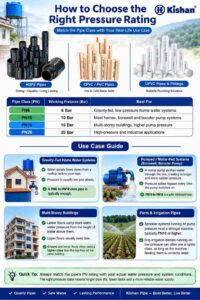
How to Choose the Right Pressure Rating (Chart + Use Cases)
This is where theory turns into a real decision. Here’s a simple pipe pressure rating chart approach based on how the pipe will actually be used.
Gravity-Fed Home Water Systems
- Water simply flows down from a rooftop tank to your taps
- Pressure is usually low and steady
- A PN6 to PN10 class pipe is typically enough
Pumped/Motor-Fed Systems (Borewell, Booster Pump)
- A motor pump pushes water through the line, creating stronger and more sudden pressure
- Pressure spikes happen every time the pump switches on
- PN10 to PN16 is a safer minimum here
Multi-Storey Buildings
- Lower floors carry more static water pressure from the height of water above them
- Upper floors usually need less
- Ground and lower floors often need a higher class than the top floor of the same building
Farm & Irrigation Pipes
- Sprinkler systems running on pump pressure need a stronger mainline, typically PN10 or higher
- Drip irrigation laterals running on low pressure can often use a lighter class, as long as the mainline feeding them is correctly rated
Common Mistakes That Cause Pipe Failure
A few avoidable habits are behind most pipe failures in Nepal. Watch out for these:
- Mixing pressure classes in one system. A pipeline is only as strong as its weakest joint, so pairing a high-pressure pipe with low-rated fittings creates a pipe fittings pressure compatibility problem right at the connection
- Ignoring water hammer. Sudden pressure surges, caused by a pump starting or a valve closing fast, can spike well above the normal steady pressure and crack a pipe that seemed adequate on paper
- Skipping temperature derating. Heat lowers a pipe’s real pressure capacity, so a pipe rated for cold water pressure will underperform if used for hot water without accounting for this
- Buying by price alone. A cheaper pipe often has a thinner wall, meaning a lower real pipe burst pressure, even if it looks identical to a properly rated one
How to Check a Pipe’s Pressure Rating Before You Buy
Before installing any pressure line, especially underground or hard to reach ones, take a minute to check the pipe itself:
- Look for the printed marking along the pipe’s length
- It should show the size, SDR value, PN class, and the manufacturing standard (such as NS 40, NS 570, or NS 206)
- If the marking is missing, faded, or unclear, treat that as a warning sign before buying
- Genuine, standard-compliant pipe will always have this information clearly printed, not just claimed verbally by the seller
These standards are set and verified by Nepal’s official standards body, the Nepal Bureau of Standards and Metrology (NBSM). If you ever want to confirm what a specific NS standard actually requires, their site is the correct source to check rather than relying on a dealer’s word alone.
Conclusion
Selecting the appropriate pipe doesn’t involve making assumptions or choosing a size that seems familiar. Understanding PN and SDR makes determining a pipe’s pressure rating as easy as determining its size. Your pipeline will function as intended if you match the rating to your system’s actual operation, whether it is gravity fed or pumped, single or multi-story, residential or agricultural. Before installing the pipe, customers in Nepalese projects should confirm its NS standard, pressure class, and written specifications.
In accordance with NS 40, NS 570, and NS 206 standards, Kishan Pipe manufactures HDPE, CPVC, and UPVC pipes in these pressure classes, with the SDR and PN ratings prominently displayed on each length. The safest course of action is usually to read the printed specs before making a purchase if you’re not sure which class is best for your project.
Frequently Asked Questions
1. What is PN Rating mean in HDPE Pipes?
PN rating in HDPE pipes refers to Nominal Pressure=PN, measured in bar. It specifies the maximum water pressure an HDPE pipe can safely handle, with common classes ranging from PN3 to PN20 under the NS 40 standard.
2. What is the difference between CPVC SDR11 and SDR13.5?
SDR11 has a thicker wall and handles higher pressure, while SDR13.5 has a standard wall thickness suited for typical residential hot and cold water lines. Both are rated for CPVC’s full temperature range.
3. Does a higher SDR mean a stronger or weaker pipe?
A higher SDR means a thinner wall and a weaker, lower pressure pipe. A lower SDR means a thicker wall and a stronger, higher pressure pipe.
4. What pipe pressure rating is best for irrigation in Nepal?
Sprinkler irrigation mainlines usually need PN10 or higher, while low-pressure drip laterals can often use a lighter class, as long as the mainline feeding the system is correctly rated.
5. What is the difference between PN rating and SDR?
PN is the actual pressure number in bar that a pipe can handle. SDR is the ratio of the pipe’s outer diameter to its wall thickness, which is what determines that pressure number in the first place.
Before you buy, it also helps to ask yourself:
- What material do you need, HDPE, CPVC, or UPVC?
- What is the maximum water temperature the line will carry?
- What is the normal operating pressure of your system, gravity fed or pumped?